
Architecting AI Inference: Balancing Compute and Data Movement for Mixture of Experts Workloads
Publié à l'origine sous le nom: Computation and Data Movement for Inference
Aperçu IA
Designing or sourcing infrastructure for MoE inference requires balancing memory bandwidth and network interconnects to prevent bottlenecks across disaggregated prefill and decode stages.
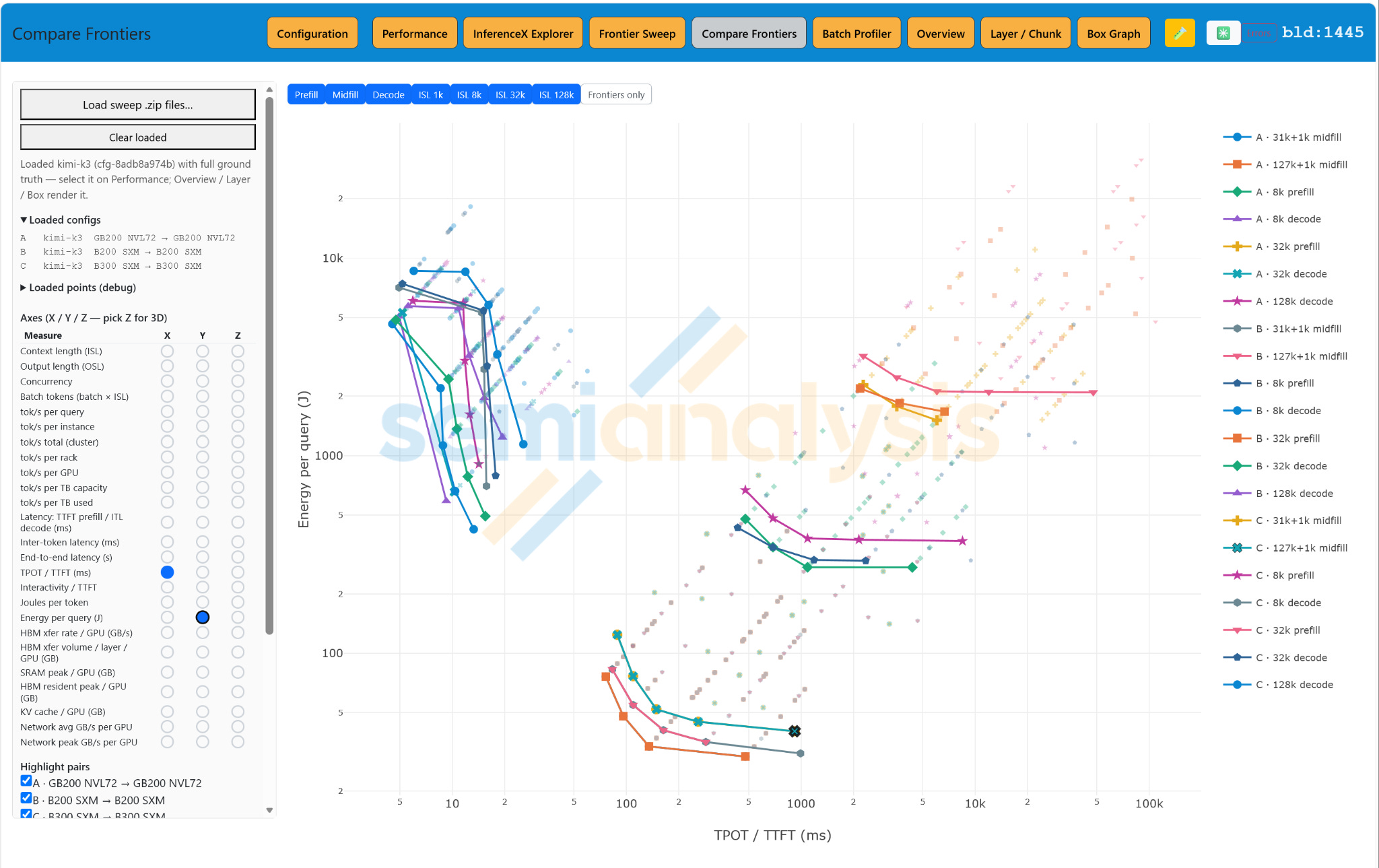
Modern frontier models utilizing Mixture of Experts (MoE) have profoundly altered the structural demands of datacenter inference. Rather than uniformly executing parameters, MoE architectures route active tensors dynamically, placing heavy demands on local memory bandwidth and cluster networking. The inference lifecycle moves through distinct operational regimes—including prefill, midfill, decode attention, and decode experts—each presenting unique arithmetic intensities and data movement profiles.
Hardware infrastructure supporting these workloads must handle heavy concurrent data traffic, from managing massive KV caches to routing weights efficiently across accelerator nodes. While prefill stages achieve high arithmetic intensity, decode phases are heavily memory-bound, requiring low-latency access to distributed weights and shared tensors. Orchestration layers and specialized network interface controllers (NICs) must coordinate tightly with accelerator nodes to maintain high token throughput across disaggregated architectures.
For system designers and hardware buyers, evaluating AI infrastructure demands a shift away from raw compute metrics toward balanced node architectures. Sourcing decisions must prioritize high-bandwidth memory (HBM) capacity, robust scale-up interconnects, and flexible networking fabrics capable of handling diverse request queues and continuous batching workloads without stalling token generation.
Questions et réponses
MoE models change active tensor dynamics, requiring distinct handling of arithmetic intensity and data movement across prefill, midfill, and decode stages.

